Kundalini is not a metaphor. It is a specific energy that lives in the human body, dormant in most people, transformative when it awakens. This is a clear account of what it is, where it comes from and what the awakening actually involves.
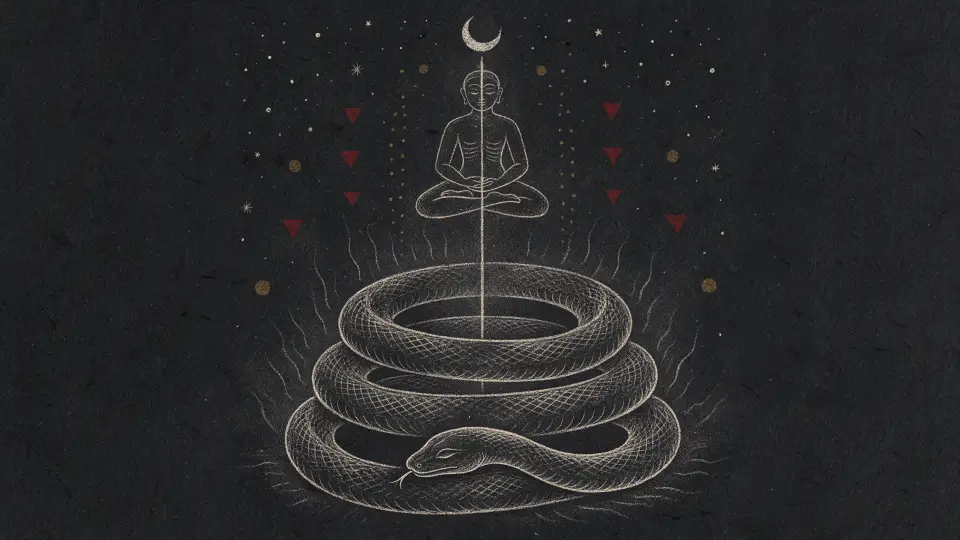
Kundalini is a Sanskrit word. Literally, it means something like "coiled one", and that coiled quality points to the nature of the energy itself. According to the yogic and Tantric traditions in which this concept originates, Kundalini is a vast reservoir of evolutionary potential that sits at the base of the spine in every human being, in a coiled, dormant state.
It is not prana, though it uses pranic channels as its vehicle when it moves. Prana is the general life-force that animates every cell and sustains every bodily function. Kundalini is something more specific: the concentrated, primordial energy of consciousness that drives the process of spiritual evolution. It has been dormant in most humans throughout recorded history, not absent, but latent, waiting for the conditions that allow it to rise.
The closest modern frame might be to think of it as a biological potential that most people never activate, like a capacity that exists in the genome but only expresses under certain conditions. That analogy is imperfect, because Kundalini is not merely biological. But the idea of dormant potential that can switch on is useful.
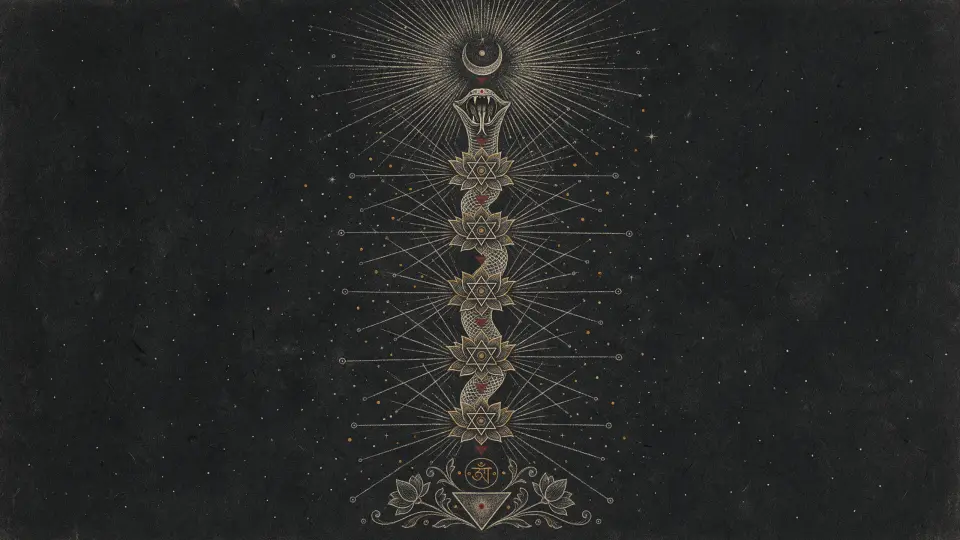
Across multiple traditions, Hindu Tantra, Tibetan Buddhism's chandali, the Taoist concept of jing, even the caduceus of Greek medicine, this primordial energy has been symbolised by a serpent. In the Tantric map, the serpent is coiled three and a half times at the base of the spine, resting at Muladhara chakra, the root centre.
The serpent is an apt symbol for several reasons. Snakes move sinuously, the way energy moves along the spine. They shed their skin, a symbol of transformation and the shedding of old identity. They represent both groundedness (close to the earth, to the body) and transcendence (the raised hood of the cobra pointed skyward). And in older cultures, the serpent was often associated with wisdom, the kind of knowledge that comes from direct encounter rather than intellectual study.
When people report the initial rising of Kundalini, they often describe it in terms that the serpent image captures: a coiling, spiralling, sinuous movement ascending through the torso, sometimes all at once, sometimes in stages.
Kundalini awakens through several distinct pathways. Understanding these pathways helps to understand why some awakenings are smooth and others turbulent.
Years of deep meditation, pranayama, mantra, and devoted practice can gradually build the internal conditions, a purified subtle body, a nervous system capable of holding expanded states, a certain quality of surrender, that allow Kundalini to rise gradually and safely. This is the traditional path. It is slow, thorough, and unlikely to produce the overwhelm that characterises some awakenings.
Shaktipat is the direct transmission of Kundalini from a practitioner in whom it has already awakened. A single transmission can initiate an awakening that would otherwise take years of practice to approach. This is not a shortcut so much as a different mechanism, transmission rather than cultivation. The results can be as profound and lasting as any other form, but they require the receiver's system to have some degree of readiness, and the integration work is still required afterward.
Kundalini sometimes rises without any deliberate practice or intention. Intense physical or emotional trauma, prolonged illness, a near-death experience, a moment of extreme surrender or devotion, any of these can trigger it. Spontaneous awakenings are often the most difficult, not because the energy itself is more intense, but because the person has no framework for what is happening and no support structure around the experience.
Intensive breathwork, certain Kundalini yoga kriyas, some forms of intense physical practice, and deep sensory deprivation or fasting have all been documented as Kundalini triggers. The mechanism is usually the same: the practice temporarily suspends the normal regulatory patterns of the nervous system and creates an opening through which the Kundalini can move.
The awakening is not something you do. It is something that happens when the conditions are right, when the vessel is ready enough to hold what rises.
When Kundalini begins to move, the effects are felt first in the body. The following are well-documented across traditions and consistent with the reports of contemporary practitioners:
The most consistent physical sign of Kundalini activity is heat, specifically, a heat that seems to originate in the lower spine or the sacral region and move upward. This is not metaphorical warmth. People measure their skin temperature rising during strong Kundalini sessions. It can range from gentle and pleasant to intense and burning, depending on the individual and the stage of the awakening.
Kriyas are involuntary movements, the body moving without intention. Swaying, rocking, spontaneous mudras (hand gestures), head rotations, rapid breathing, jumping, or vibratory movement can all occur. They represent the energy moving through the system and clearing blockages in the nadis (subtle energy channels). In traditional settings, kriyas are understood as purification, not pathology.
As Kundalini moves through the higher energy centres, perception begins to change. The boundary between self and environment becomes more fluid. A sense of spaciousness, timelessness or unity arises. Some people enter samadhi, a state of absorbed, thoughtless awareness in which the ordinary sense of being a separate subject temporarily dissolves.
Colours appear more vivid. Music produces more intense responses. The senses register more without the usual filtering. This is not psychedelic in the pharmacological sense, it arises from within the person's own system, without external substances, but the phenomenology can be similar.
Old emotional material surfaces and releases. Periods of grief, joy, awe, or clarity appear without obvious external trigger. These are part of the cleansing aspect of the awakening, the energy moving through psychological structures and releasing what has been compressed or suppressed.
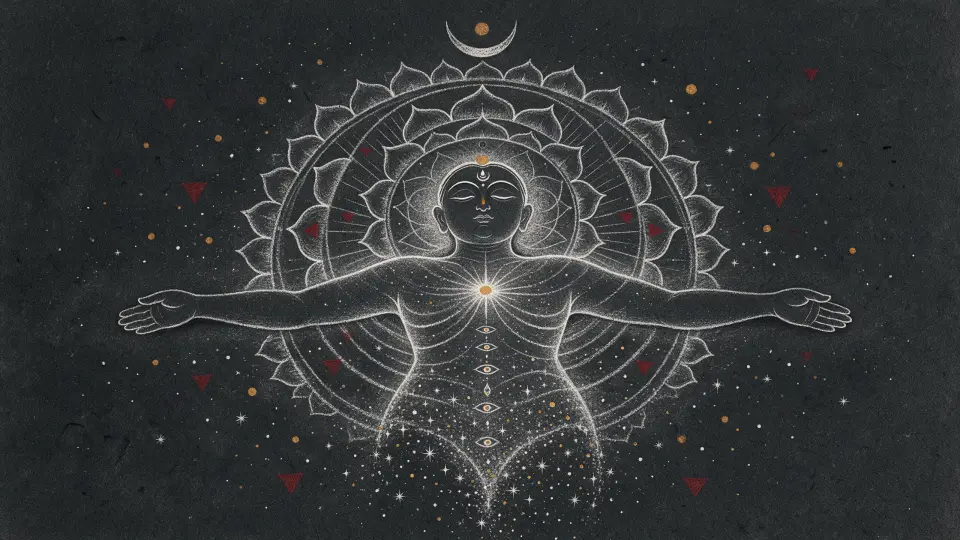
In the Tantric model, Kundalini travels through a central channel called the sushumna nadi, passing through a series of energy centres, the chakras. The word chakra means "wheel," and these centres are understood as points where the subtle body organises and concentrates energy.
Each chakra is associated with specific qualities of experience, different patterns of consciousness, different capacities, different ways of being in the body and the world. As Kundalini rises and opens each centre, those qualities become available at a new level of integration.
The path is not necessarily linear, and the awakening does not always proceed neatly from base to crown. In many awakenings, the energy begins activating multiple centres simultaneously, or oscillates between them, or seems to bypass some and concentrate in others. The map is useful as orientation, not as a fixed itinerary.
On chakra culture: The word "chakra" has become widespread in wellness culture, often reduced to colour associations and crystals. The traditional understanding is more rigorous and more interesting than this: the chakras are functional structures of the subtle body, not primarily symbolic or decorative. Kundalini's interaction with them is a technical, energetic process.
The traditional goal of Kundalini awakening in Tantric and yogic systems is the union of Shakti (the energy that rises) with Shiva (the pure consciousness at the crown). This union represents the reintegration of individual consciousness with universal consciousness, what different traditions call liberation, self-realisation, or enlightenment.
What this looks like in practical terms varies widely. For many people, the awakening produces a fundamental shift in how consciousness operates: less fixation on the content of thought, more stability in the ground of awareness that underlies thought. Fear of death diminishes. Compassion deepens. The sense of being a separate self that must defend itself against the world loosens without disappearing.
This does not happen all at once. The Kundalini process is not a single event but a trajectory. It can unfold over years or decades. Many people who receive Shaktipat enter an awakening process that continues to develop long after the initial transmission.
What makes the awakening valuable is not the experiences it produces, the lights, the kriyas, the bliss. Those are byproducts. What is valuable is the change in how consciousness operates, day to day, in the midst of ordinary life. That is what the traditions mean when they say Kundalini is the path to liberation: not liberation from the world, but liberation within it.
Further reading: Krishna, Gopi. Kundalini: The Evolutionary Energy in Man. Shambhala Publications, 1967. Muktananda, Swami. Play of Consciousness. SYDA Foundation, 1978. White, David Gordon. The Alchemical Body: Siddha Traditions in Medieval India. University of Chicago Press, 1996.
Is Kundalini energy dangerous?
Kundalini is not inherently dangerous. Difficulties arise when the energy activates faster than a person's nervous system and psychological structure can integrate it. This is more likely with certain practices done intensively without guidance, or when a spontaneous awakening occurs in someone with no prior framework for what is happening. Working with an experienced practitioner significantly reduces the risk of overwhelming or destabilising experiences.
How do I know if my Kundalini is awake?
The clearest signs are felt in the body: heat or movement along the spine, spontaneous kriyas, unusual energy surges, altered states during meditation or rest, and changes in perception that are difficult to account for otherwise. Sustained changes in how consciousness feels, less separation, more presence, a shift in what matters, are also indicators. See the page on Kundalini awakening signs for more detail.
Can Kundalini energy be activated through yoga?
Some yoga practices are specifically designed to work with Kundalini, Kundalini yoga as taught by Yogi Bhajan, certain kriyas in classical hatha and Tantric systems. These can build the energetic conditions that support awakening. They can also activate Kundalini directly in people who are ready. However, yoga practice alone rarely produces the kind of full awakening that Shaktipat transmission can initiate.
What is the difference between Kundalini and prana?
Prana is the general life-force energy that animates the body. It circulates through all the nadis and sustains every function. Kundalini is specific: it is the dormant evolutionary potential coiled at the base of the spine, distinct from the prana that already flows. When Kundalini awakens, it uses the pranic system as its vehicle, which is why Kundalini experiences often produce intense pranic activity, but the two are not the same thing.